The opening of Sunrise Village feels like the first chapter of a children’s book you half remember. Your grandfather has summoned you; a stone circle has appeared out of nowhere; the village beyond it is wrapped in vines and smothered in fog. Nobody is in danger, exactly. Things have simply been left too long, and you are the one who has arrived to set them right.
That framing matters more than it seems. Plenty of farm games ask you to plant because planting is what farm games do. Here, every field of peas feeds a purpose: a neighbour needs plywood for a workshop, a path needs clearing so you can reach the next cottage, a legend about artisans and six magical crystals needs a little more digging. The chores are familiar. The reason for them is what keeps you warm.
Peas, hay and the slow rhythm of the fields
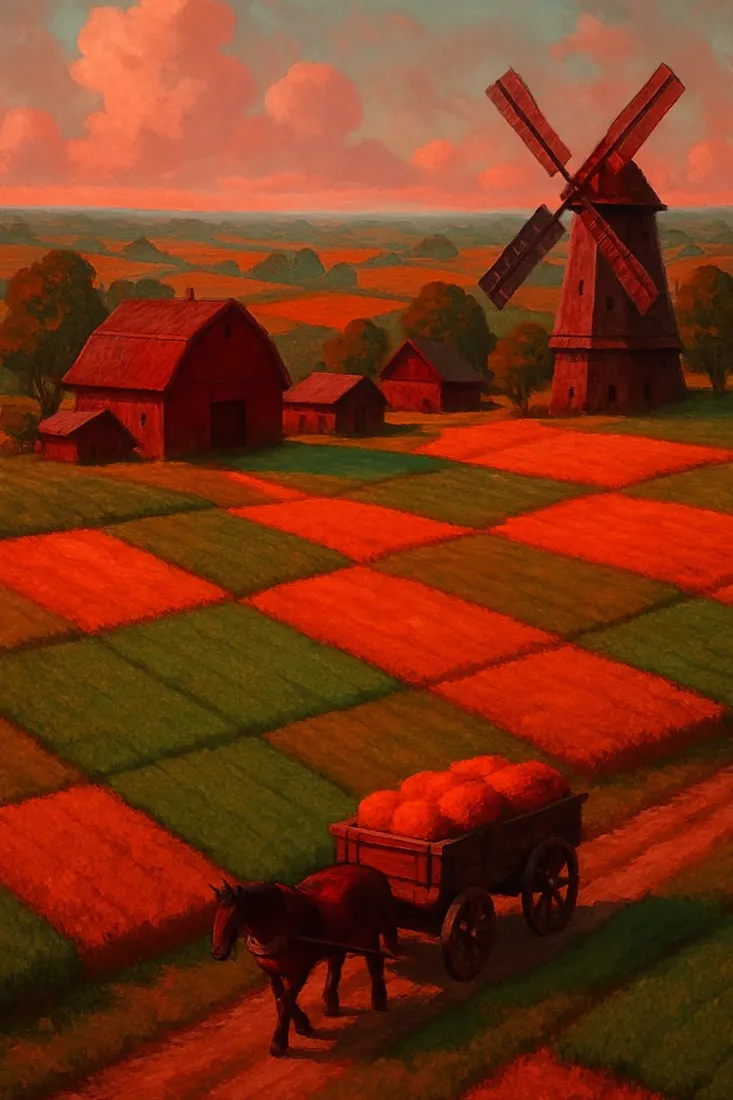
The farming itself is simple and tactile. You harvest vegetables such as peas, turn raw materials into goods like hay and plywood, and keep chickens and cows ticking along in their pens. None of it is complicated, and that is the point: within ten minutes you understand the loop well enough to stop thinking about it and start enjoying it, the way you stop thinking about chopping onions once your hands know how.
What gives the fields texture is how they connect to everything else. Production buildings need inputs from the farm, quests ask for specific goods, and the valley’s repairs swallow materials in satisfying quantities. You start each session with a small plan — get enough hay for that request, plant something before logging off — and the game is very good at letting that plan feel like a complete little evening.
Neighbours who give the chores a reason
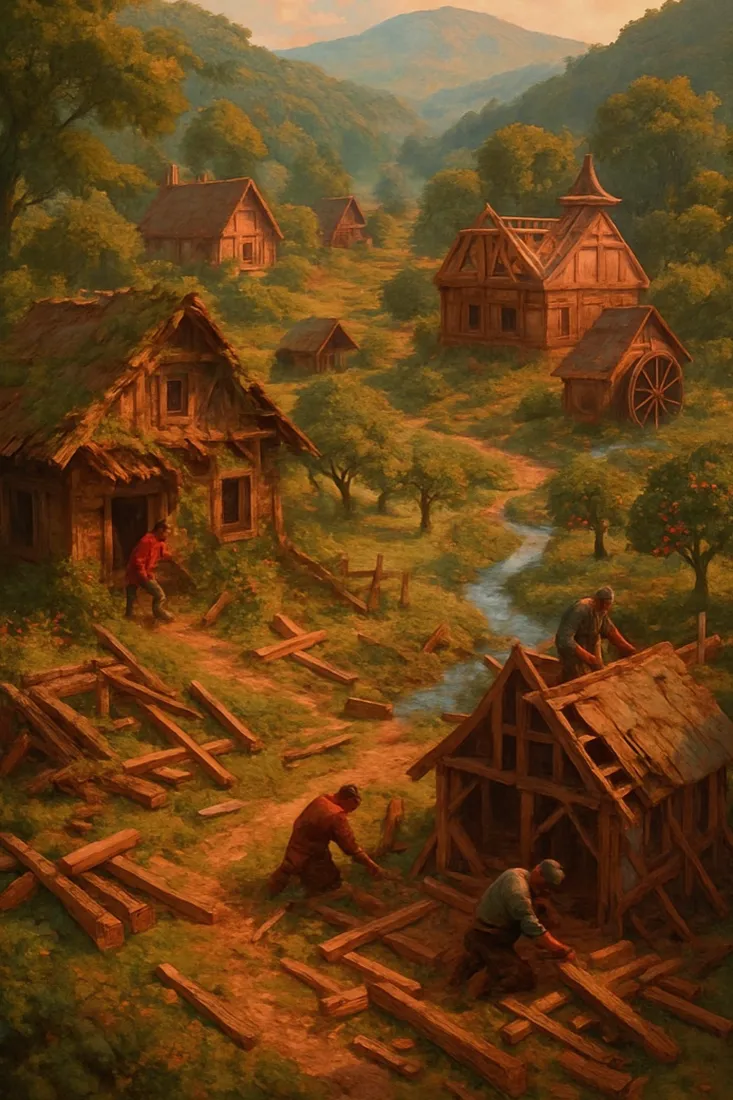
The villagers are the heart of it. As the fog lifts you meet friendly residents who need help repairing their houses and workshops, and each restoration opens a new strand of quests. It is a modest kind of storytelling — short exchanges, clear requests, a little humour — but it lends the valley a sense of community that mechanics alone could never supply.
There is a mystery humming underneath, too. The stone circle and the legend of the crystals give the long game a destination, and the hot-air balloon you eventually build lets you travel across a world map and unlock new lands. We liked that the larger story never shouts. It waits at the edge of the village, ready for whenever you feel like wandering further up the valley.
Energy: a gentle brake rather than a wall
Clearing overgrown land and doing many actions costs energy, and when it runs low you either wait or find ways to generate more. Some players bristle at this kind of limit. On a cosy shelf, we think it is closer to a feature. It draws a natural line under a session so you never end up playing for three hours when you meant to play for twenty minutes.
The flip side is that free players do feel the brake more on busy days, and the shop will happily offer to loosen it. We never paid during our review and still made steady, pleasant progress, but anyone who likes to binge on a Saturday afternoon will hit the edge sooner. That is why our free-player score sits a notch below the rest of the card.
Small visits from the couch or the commute
Sunrise Village plays in a desktop browser and also has phone apps, which suits its rhythm well. We found ourselves starting a few tasks at the desk after dinner, then checking the fields again on a phone later in the evening. Short visits feel just as worthwhile as long ones, because there is nearly always a crop to collect or a request to tick off.
Visually it is the prettiest game we reviewed: soft colours, rounded buildings and a valley that looks noticeably happier as the vines retreat. On a dark February night in Ottawa, watching a meadow turn green again is a small, real comfort. If cosy games are about atmosphere as much as mechanics, this one understands the assignment better than most.
Easing into Sunrise Village
- Follow your grandfather’s early quests closely; they teach the farming loop and open the first repaired buildings without any guesswork.
- Keep a crop growing whenever you log off so there is always something ready to harvest when you come back.
- Spend energy on clearing land that leads somewhere — towards a villager’s house or the next path — rather than random patches.
- Read the villagers’ requests before producing goods, so your hay and plywood go straight into repairs instead of piling up.
- Stop when your energy runs low. Coming back tomorrow is part of the game’s design, not a failure of planning.
What we love
- A story-led reason behind every field, request and repaired cottage in the valley.
- The prettiest art on our shelf, and a village that visibly brightens as you work.
- Energy limits that naturally end a session before it eats the evening.
- Works equally well in a browser or on a phone for quick check-ins.
What grates
- Free players feel the energy brake more sharply during long weekend sessions.
- The shop appears often enough to break the spell now and then.
- Early quests can feel slightly hand-holding for people who know farm games well.
Who Sunrise Village will charm
Sunrise Village is for anyone who loves the idea of a fixer-upper — a cottage, a garden, a whole forgotten valley — and wants a gentle story to keep them company while they work. It is especially kind to people with busy days who can only offer the game small, regular visits.
Settling on Sunrise Village
No other game on our shelf makes restoration feel quite so much like coming home. The farming is light, the villagers are warm, the art is lovely and the energy system, for all its occasional frustration, protects your evening from itself. Heavy players will want more freedom, and the shop is never far away. For slow, contented progress with a story attached, this is where we would start.