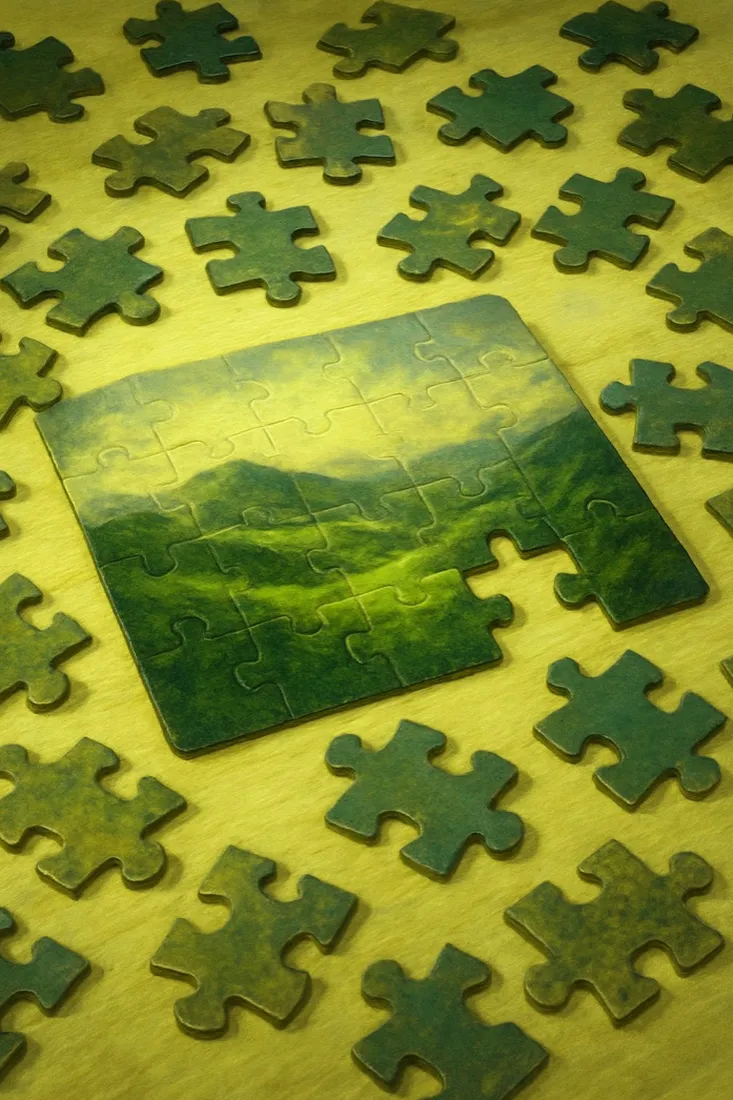
Every other game on our shelf asks you to look after something. Jigsaw Planet asks nothing of you at all. You open the site, pick a picture, and a puzzle appears, ready to be scattered across your screen. There is no account to create before you begin, nothing to install, no progress to protect. It is the closest thing the web has to tipping a box of pieces onto the kitchen table.
That simplicity is why it scores a perfect ten for calm and a modest mark for depth. Jigsaw Planet is not a game in the progression sense; it is a tool and a library, fed by its community. But on a night when even watering virtual tomatoes feels like a chore, nothing on our list is more restful than sorting edge pieces while the radio murmurs.
Choosing your pieces, cuts and rotation
The settings are where Jigsaw Planet quietly shines. Through a puzzle’s custom play option you can change the number of pieces — the site’s own help pages list a range from 4 to 300 — pick from several cut shapes, and switch random rotation on or off. A four-piece puzzle for a small child and a fiendish rotated three-hundred-piecer can come from the same photograph.
Rotation deserves a special mention. With it switched on, pieces arrive turned at random and must be rotated as well as placed, which the help section warns makes things noticeably harder. We found it transformed familiar pictures into genuinely meditative challenges. Without it, the experience is breezy and quick, ideal for a short break between other things.
Turning your own photos into evening puzzles
The create option lets you upload an image and turn it into a puzzle, which is where Jigsaw Planet becomes personal. A snapshot of the cottage from last summer, the dog asleep in a sunbeam, a frosty morning on Lake Louise — each becomes a little project you can solve yourself or send to someone else.
Puzzles can live in public albums, where anyone can find and play them, or private albums only you can see. Public ones can be shared or embedded on websites, which makes the site handy for sending a puzzle to a grandparent across the country. We loved being able to tune piece counts for different people: a gentle forty for one relative, a hundred and fifty for another.
Browsing a library built by its players
Because the puzzles come from the community, the library is enormous and wonderfully uneven. You can browse the newest uploads, the week’s most played and the all-time favourites, or follow a particular creator by visiting their profile. Some pictures are breathtaking photography; others are somebody’s cat. Both have their place on a slow evening.
There is also a weekly community challenge called Puzzle of the Week, with a theme posted on the create page and entries tagged accordingly. It gives creators something to aim for and gives browsers a fresh, curated thread to follow. The flip side of a community library is that quality varies, and you will occasionally scroll past a blurry upload or two.
Small rough edges on a smooth experience
Jigsaw Planet is funded by advertising, and the help pages are candid about it, asking ad-blocker users to make an exception. Banners are the price of unlimited free puzzles. We found them unobtrusive during play itself, though browsing the library is busier than the clean puzzle board.
The site also saves unfinished puzzles so you can return later, which is a real kindness for a large rotated jigsaw. A clock keeps track of your time if you like to measure yourself against it, and is easy to ignore if you do not. Our only wish is for a little more editorial curation: the best pictures can be buried under the sheer number of uploads.
Easing into Jigsaw Planet
- Start with a small puzzle of around fifty pieces to learn the controls and how pieces snap together.
- Try the same picture again with rotation switched on, and notice how much more absorbing it becomes.
- Browse the week’s most played list to find well-loved images rather than scrolling the newest uploads.
- Upload one of your own photos and play it in a private album before sharing it with family.
- Leave a large puzzle half finished overnight and see how pleasant it is to return to it.
What we love
- Open a puzzle in seconds without signing up or installing anything.
- Flexible piece counts, cut shapes and rotation from one picture.
- Turning your own photos into shareable puzzles is genuinely delightful.
- Unfinished puzzles are saved, so big ones can stretch across evenings.
What grates
- No progression or story, so motivation depends entirely on the pictures.
- Community uploads vary widely in image quality.
- Browsing pages carry noticeably more advertising than the puzzle board.
Who Jigsaw Planet will charm
Jigsaw Planet is for anyone who finds jigsaws soothing but lacks the table space, the patience for missing pieces or the budget for new boxes. It is also a lovely way to share photos with family, especially relatives who would rather solve a picture than scroll through one.
Settling on Jigsaw Planet
It is not deep, and it does not pretend to be. Jigsaw Planet is a simple, flexible and almost entirely frictionless way to do one of the oldest relaxing activities there is. Fine control over pieces and rotation, private photo puzzles and a vast community library make it our go-to when a game feels like too much. On calm alone, nothing beats it.